Sevak Das
| Select | Format | INR(₹) |
|---|---|---|
| Print Book | 2,950.00 |
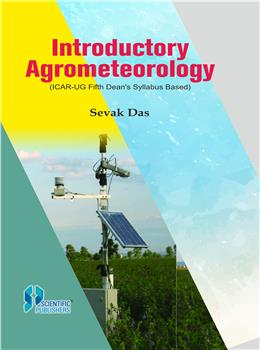
This book is prepared and compiled with a series of diagrams, pictures that illustrate the principles of Agricultural Meteorology which are fundamental to the understanding of the subject by students and other readers. Each chapter contains the basic aspects and principles of agricultural meteorology and formatted easy to understanding by the readers.
Generally, it includes introduction to agricultural meteorology; weather, climate and seasons; earth’s atmosphere and its and divisions; pressure belts and wind pattern on globe; condensation and precipitation; mechanism of Indian monsoon; solar radiation and energy balance; role of weather and climate in crop production; climatic hazards in agriculture; weather forecasting and agroadvisory services; crop microclimate and its modifications; crop weather simulation modeling; climate change and agriculture; basics of animal climatology; remote sensing in agriculture; electromagnetic radiation; Agro-climatic zones of India and Gujarat; agro-meteorological instrumentation etc. It also contains terminology of agricultural meteorology and objectives questions of agricultural meteorology.
The present book ‘Introductory Agrometeorology’ contains basic and various applied aspect of meteorology in agriculture. The present book will be a valuable source of information for students and teachers engaged in the field of Agricultural Meteorology.
1: Introduction to Agricultural
Meteorology
2: Weather, Climate and Seasons
3: Earth’s Atmosphere and its
Divisions
4: Pressure Belts and Wind Pattern
on Earth’s Globe
5: Condensation and Precipitation
6: Mechanism of Indian Monsoon
7: Solar Radiation and Energy
Balance
8: Role of Weather and Climate in
Crop Production
9: Climatic Hazards in Agriculture
10: Weather Forecasting and
Agroadvisory Services
11: Crop Microclimate and its
Modification
12: Crop Weather Simulation
Modeling
13: Climate Change and Agriculture
14: Basics of Animal Climatology
15: Remote Sensing in Agriculture
16: Electromagnetic Radiation
17: Agro Climatic Zones of India and Gujarat
18: Agrometeorological Instrumentation
18.1 Site selection and layout of meteorological observatory
18.2 Measurement of rainfall
vi Introductory Agrometeorology
18.3 Measurement of air and soil temperature
18.4 Determination of relative humidity and vapour pressure
18.5 Measurement of bright sunshine hours
18.6 Measurement of wind speed and direction
18.7 Measurement of evaporation
18.8 Measurement of atmospheric pressure
18.9 Measurement of AET by Lysimeter
18.10 Measurement of evapotranspiration (ET) by various methods
18.11 Study of automatic weather station (AWS)
Terminology of Agricultural Meteorology.
Objective Question of Agricultural Meteorology
19.1. Answer key of objective
questions
1: Standard Meteorological
Week (SMW)
2: Hygrometric Table
3: SVP at Dry Bulb and Wet
Bulb Temperature (mb)
4: Extra-terrestrial
radiation (ra) expressed in equivalent evaporation (mm-1)
5: Mean Monthly values of
Extra-terrestrial Radiation (cal/cm2/day)
for different latitudes
6: Maximum possible hours of Sunshine (N) for different latitudes in Northern Hemisphere
7: Monthly mean weather parameter of Sardarkrushinagar (1991-2020)

SCIENTIFIC PUBLISHERS
"Granthlok"
5-A,Pali Road,
Bhagat Ki Kothi (Near Riktiya Bheruji Circle)
Jodhpur, Rajasthan
PIN - 342 001, INDIA
WhatsApp: +91-77339-04904
Enquiry: +91-95211-31111
Orders: +91-99292-72222
Publishing
Books: +91-97999-91782
Journals: +91-98299-89666
Tel: +91-291-2433323
DELHI
"Granthlok"
4806/24, Ansari Road, Bharat Ram Road, Darya Ganj New Delhi 110002 INDIA
Tel: +91-11-47590696
Email: info@scientificpub.com
Make sure you dont miss interesting happenings
by joining our newsletter program
Government e Marketplace (GeM) is a 100 percent Government owned & National Public Procurement Portal.GeM is dedicated e market for different goods.
© 2025 SCIENTIFIC PUBLISHERS | All rights reserved.