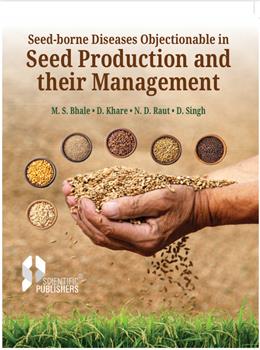
M.S. Bhale , Dhirendra Khare , N.D. Raut & D. Singh
| Select | Format | INR(₹) |
|---|---|---|
| Print Book | 2,950.00 | |
| Individual E Book | Coming Soon.. | |
| Institutional E Book | Price available on request |
The development of an improved agriculture is an indispensable step towards better living standards. It depends upon improved inputs of which seed is the most significant. Seed has always been regarded as the most vital, basic and critical input. Sage Parashara (circa 400 BC) had said, "the origin of plentiful yield is the seed". Today, more than two millennia later, the statement holds true and it will be hold true as long as humans inhabit the earth. Seed health is a priority area in seed production programme. In recent years, the awareness for seed health has increased among the growers, traders, consumers and policy makers. In post -GATT era and with the emergence of WTO concerns regarding the seed health have acquired high importance. In seed production programme, seed certification standards have been worked out. Several diseases have been designated objectionable at field and seed levels. The book provides comprehensive and integrated information on 57 seed-borne diseases covering about 40 major field and vegetable crops. The information is supplemented with about 127 photographs, explanation of technical words in glossary and further readings. The book will be of great help to the people engaged in seed production (fields and vegetable crops), seed certification, agricultural extension workers, field workers and seed industry. It will be of immense use for all the teachers, students and researchers of seed science and technology.

Y.L. NENE
Chairman Asian Agri-History Foundation Secunderabad, 500 009 AP India.
Introduction
1. Role of seed- borne pathogens
2. Significance of seed health testing
2.1 Seed health testing methods
2.1.1 Testing for seed-borne fungal pathogens
2.1.2 Testing for seed-borne bacterial pathogens
2.1.3 Testing for seed-borne viral pathogens
2.1.4 Testing for seed-borne nematode pathogens
2.2 Scope of seed health testing methods
2.3 Protocols for some common methods employed in seed health testing
3. Management of seed-borne diseases: an integral approach
4. Present status of Indian seed sector and seed-borne diseases in seed production
4.1 Seed sector
4.1.1 Seed research in agricultural production
4.2 Seed-borne diseases
5. Identification and management of objectionable seed borne diseases
5.1 Loose smut of wheat
5.2 Karnal bunt of wheat and triticale
5.3 Ear cockle of wheat
5.4 Bunt of rice
5.5 Downy mildew of sunflower
5.6 Downy mildew ( green ear) of pearl millet
5.7 Ergot of pearl millet
5.8 Grain smut of pearl millet
5.9 Head smut of sorghum
5.10 Kernel smut of sorghum
5.11 Ergot of sorghum
5.12 Loose smut of oat
5.13 Loose smut of barley
5.14 Cercospora leaf spot of sesame
5.15 Halo blight of green gram
5.16 Jute chlorosis
5.17 Anthracnose of chillies
5.18 Leaf blight of chillies
5.19 Anthracnose of French bean, cow pea, Indian bean and cluster bean
5.20 Ashy stem blight of cow pea
5.21 Ascochyta blight of cow pea and French bean
5.22 Bacterial blight of Indian bean and cluster bean
5.23 Ascochyta blight of cluster bean ( guar)
5.24 Bean common mosaic of French bean
5.25 Phomopsis blight and fruit rot of egg plant
5.26 Black rot of cauliflower
5.27 Black leg of cabbage
5.28 Bacterial soft rot of cabbage, cauliflower, broccoli, knol- khol and multiplier onion
5.29 Basal rot of multiplier onion
5.30 Early blight of tomato
5.31 Leaf spot of tomato
5.32 Mosaic of tomato (TMV)
5.33 Leaf spot of parsley and celeriac (Turnip rooted celery)
5.34 Leaf blight of celery
5.35 Root rot of celery
5.36 Mosaic of lettuce
5.37 Mosaic of musk melon and summer squash
5.38 Mosaic ( WMV) of summer squash
5.39 Wilt of sweet potato
5.40 Scurf of sweet potato
5.41 Black rot of sweet potato
5.42 Storage rot of sweet potato
5.43 Internal cork of sweet potato
5.44 Sweet potato nematode
5.45 Common mosaic of tapioca (cassava)
5.46 Phytophthora blight of taro (colocassia)
5.47 Mosaic of taro
5.48 Brown rot of potato and TPS
5.49 Mild mosaic of potato
5.50 Severe mosaic of potato
5.51 Leaf roll of potato
5.52 Wet rot of potato
5.53 Late blight of potato
5.54 Fusarial dry rot of potato
5.55 Charcoal rot of potato
5.56 Common scab of potato
5.57 Black scurf of potato
6. Future needs
7. Glossary
8. Suggested readings
Index
SCIENTIFIC PUBLISHERS
"Granthlok"
5-A,Pali Road,
Bhagat Ki Kothi (Near Riktiya Bheruji Circle)
Jodhpur, Rajasthan
PIN - 342 001, INDIA
WhatsApp: +91-77339-04904
Mobile: +91-92514-76033
Phone: +91-291-2433323
Working Hours: Monday to Saturday
10:00 a.m.-6:00 p.m. (IST).
Email: info@scientificpub.com
Make sure you dont miss interesting happenings
by joining our newsletter program
Government e Marketplace (GeM) is a 100 percent Government owned & National Public Procurement Portal.GeM is dedicated e market for different goods.
© 2026 SCIENTIFIC PUBLISHERS | All rights reserved.