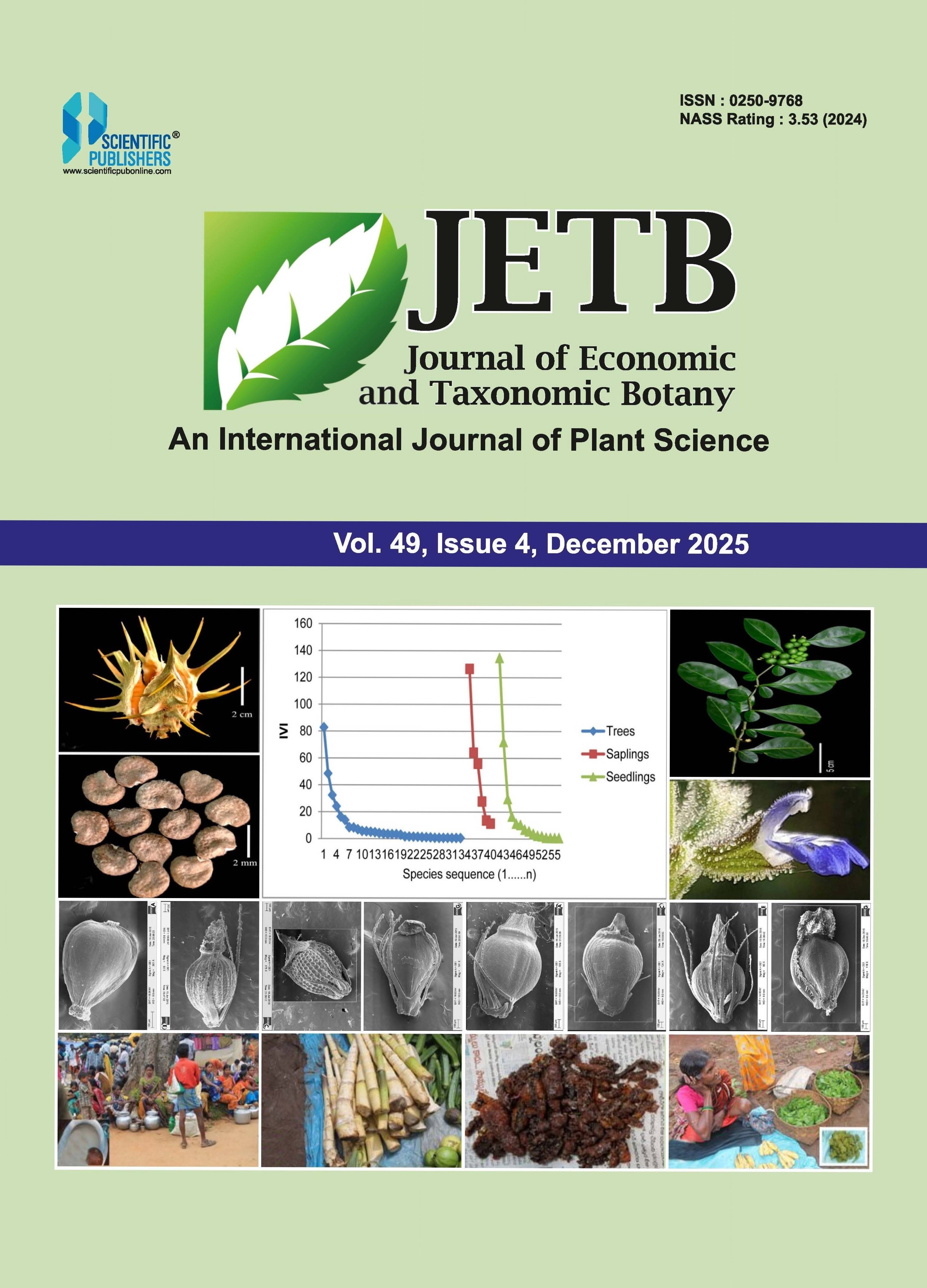
The random sampling study of forest stand structure and regeneration potential of Bethuadahari wildlifes sanctuary revealed the presence of three growth-layers in the forest stand (adult trees, saplings and seedlings). of the 33 tree species documented, the Fabaceae alone are represented by seven species followed by Moraceae (Ficus with 4 spp.). The Shannon-Wiener indices (H) for trees was 2.28, saplings 1.48, and seedlings 1.69, indicating a moderate density. Concentration of dominance and evenness indices for trees, saplings and seedlings were 0.16, 0.27, 0.27 and 0.3, 0.73, 0.36, respectively. The tree density and basal cover was found to be 378.24 indivs./ ha-1 and 42.16 m2/ha-1, respectively for trees, 673.91 indivs./ha-1 and 2.87 m2/ha-1 , respectively for samplings and 805.22 indivs./ha-1 and 0.43 m2/ha-1, respectively for seedlings. Tectona grandis was the most dominant species (IVI: 83.07). Only nine species showed ‘good’ regeneration, three each ‘fair’ and ‘poor’ regeneration whereas the rest (majority: 18 spp.) showed no regeneration. Overall, the sanctuary with seedlings>saplings>trees showed good regeneration potential. Most of the tree individuals being of lower diameter classes (10–20 cm and 20.01–30 cm) indicate the plant community of the sanctuary is in evolving stage